 Age restrictions on children’s access to social media are gaining momentum around the world, with governments increasingly considering age bans as a response to concerns about children’s safety and wellbeing online.
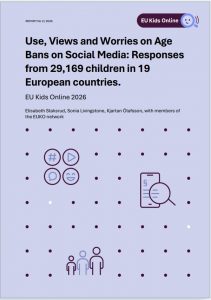
The new EU Kids Online report Use, views and worries on age bans on social media draws on survey responses from 29,169 children aged 9–16, from 19 European countries collected between April 2025 and April 2026.
The findings report children’s screen use across the day, their online activities, who has a social media profile, experiences of safety and communication online, exposure to harmful content, children’s worries and their views of age-based restrictions.
How children spend their time online
The survey shows that children’s online lives are deeply embedded in their everyday social, educational and leisure activities. The internet seems less a separate space from offline life and more continuous with everyday social interaction.
Digital device use peaks after school, followed by use in the evening before bedtime. It appears that children’s digital media use is concentrated during leisure time, not during class or at night.
Communication with friends is the most frequent activity, followed by watching videos on social media, listening to music and communicating with parents or caregivers. Beyond these top activities, children engage in a wide range of online activities, with considerable variation across the population.
Social media use increases strongly with age, but it also begins before the mid-teen years. Across six countries, 34% of 9–11-year-olds, 70% of 12–14-year-olds and 89% of 15–16-year-olds report having a social media profile.
Children’s online experiences are mixed
Many use the internet for social connection, entertainment, learning and information. Some report exposure to risks, including potentially harmful content, image-based abuse concerns, pornography, eating-disorder content and misinformation.
Only half (48%) say they feel safe online. 6 in 10 children (61%) say they know what to do if someone acts online in a way they do not like.
Up to one in five 9–16-year-olds in Europe report encountering some forms of problematic user-generated content. Harmful content is reported mainly by older teenagers. Conspiracy theories are the most commonly reported type overall, supporting widespread concerns about misinformation and disinformation online.
Children’s worries are not limited to social media
Although image-based abuse and fake images are important concerns, their top worries are broader, including family illness or death, war, future employment and school achievement.
Children from lower socio-economic homes were more likely to search online for information about mental health and wellbeing. Children from low socio-economic status (SES) homes are twice as likely as better-off children to look for new contacts online or publicly share some information about themselves in a way that it could be viewed by people they had never met before, which suggests they may be more at risk.
Children are highly ambivalent about age-based restrictions
The study found that 33% say they would feel safer online, 45% disagree. Their concerns relate to freedom, responsibility, social connection, education, and democratic participation.
The findings show patterns of exposure, not simple causality. They do not establish whether social media causes harm, whether vulnerable children are more likely to encounter or seek out certain content, or whether online and offline difficulties reinforce each other. Exposure does not automatically mean harm, and risks vary by age, gender, socioeconomic status, vulnerability, intention and platform context.
Overall, the findings do not support a simple interpretation that access to social media is either clearly safe or clearly harmful.
While age bans, if they can be effectively implemented, may address some risks for some younger children, the findings show that this would be at the cost of important online opportunities.
Social media bans are unlikely to be effective or sufficient on their own. A more balanced approach would combine age-appropriate protections, safety-by-design, platform accountability, digital literacy, support systems and attention to children’s rights to participation, information and social connection.
In conclusion, we suggest that the findings clearly point to a safety-by-design, or indeed a child rights-by-design, approach, as set out in the guidelines to Article 28 of the Digital Services Act.
Read EU Kids Online’s statement cautioning against outright bans.